
In 1996, Larry Page was a PhD student at Stanford. Just the right time and place to be a protagonist on the rise of the nacient internet. Back then, most search engines were trying to figure it out how to provide better ranking results automatically. They were all reading the content of webpages, using keywords, text parsing, in-page signals, and so on. But Larry tried something different.
He asked a different question:
“What if a page’s value is not about the information it contains, but in how many other pages point to it?”
That reframing became the PageRank algorithm, a ranking system built on the web’s hyperlink graph (not just its text).1 The rest is hitory, PageRank helped shape what later on became the dominat search engine and one of the most prominet companies in the wrold: Google.
But this post is not about the history of web or search engines (I wrote another post about it). It’s about another kind of engine. The engine behind human breakthroughs, something we call: creativity as perspective-shift.
We are now in AI era.
Right now, LLMs can generate thousands of surprisingly “good” outputs.
However, they still struggles to choose what is worth building, what is actually relevant (and why).
It’s my believe that this selection function (taste, judgment, values) is where humans still keep an edge over AI.
So, in this post, I’ll cover three things:
- Why creativity just became the most practical skill for humans.
- How creativity works according to what research suggests is happens in our minds.
- How you can grow your creativity with simple, repeatable practices.
Let’s dive in!
Creativity ≠ Productivity
Recently, I put a lot effort to bully my brain into being creative. I treated creativity like productivity and assumed intensity would eventually pay off. So I tried to focus harder, longer, and with more discipline than ever. The result was more effort and fewer breakthroughs.
Creativity doesn’t reward effort the way execution does.
Creativity prefers slack, not strain. Neuroscientists describe a relevant system called the Default Mode Network (DMN), which becomes more active when you’re at rest and thinking internally.2 The DMN is linked to mind-wandering, memory, and our ability to recombining unrelated things into new patterns.3
In plain terms, the DMN is brain’s background “merge request” process. When you never give it idle time, nothing new gets merged.
So instead of focus harder, what I do is to switch states.
One well-known study found that an undemanding task that allows the mind to wander can improve creative incubation compared to staying locked in.4
But this doesn’t mean boredom is magical. It means boredom is permissive, and your brain takes the permission seriously. If you want originality, you the best way is to stop supervising every thought.
Now when I’m stuck, I stop trying harder and start making space.
- I walk without inputs (no phone, no podcast).
- I do dishes, clean the floor, or do something else.
- I take the boring route home.
Then, I let the brain do what it does when nobody is watching: wandering about things.
Feed the Blender
Here’s the thing. Your brain is not a laser. It’s more like a blender. What comes out depends on what goes in. If your inputs are all the same creators, the same feeds, the same opinions, your creative output becomes high-resolution déjà vu.
A smarter strategy is to diversify the ingredients, not increase the volume.
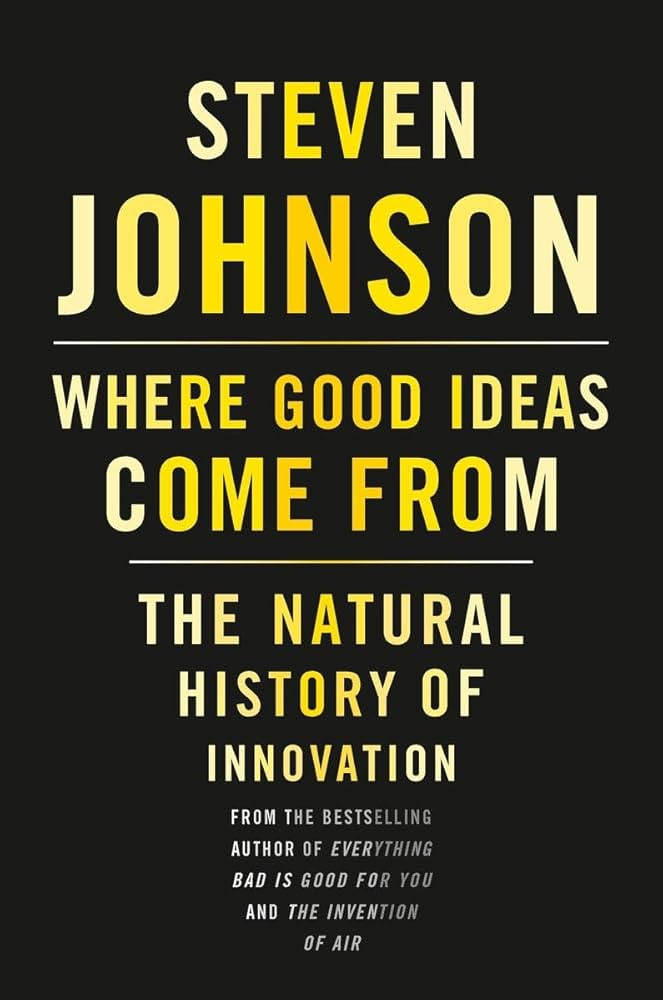
Steven Johnson describes breakthrough environments as liquid networks: idea ecosystems where half-formed hunches collide, combine, and evolve.5
This matters because creativity is often the product of collisions of new ideas, not contemplation of what’s alrady known. If you only consume polished conclusions, you train your mind to reproduce conclusions. If you collect fragments, you give your mind raw material. This is how random insights become repeatable.
So build a liquid network on purpose.
For example:
- Watch a YouTube video with under 1K views (there are many of then in my YouTube channel)
- Read an old essay from last century.
- Open a weird old book from another field (history, biology, architecture).
- Talk to someone outside your network and ask what they’re obsessing over.
Most of it will be useless (that’s the price of finding the one useful oddity). But one strange idea can spark ten better ones.
George Mack argues for hunting “anti-social proof” inputs (i.e., good ideas that haven’t been blessed by the algorithm yet).6
I believe the post-2022 internet is increasingly saturated with synthetic sameness, so new is not the same thing as novel.
So the goal is definitely not consume more, the goal is consume with rarity as the intent.
Cause sometimes the best way to think differently is to stop drinking from the same firehose.
Translate Aggressively
If you want a new idea, change the format.
- If your idea is written, read it out loud.
- If your idea is visual, write it as prose.
- If your idea is very technical, explain it to a five-year-old.
Each translation forces the brain to rebuild the idea, not just rephrase it.
Cognitive scientists call this conceptual blending: Combining elements from different mental spaces into a new structure with emergent meaning.7
This is why changing the medium often changes the idea. With this technique, you’re not just changing representation, you’re changing which associations become available.
So when you’re stuck, don’t think harder. Think sideways. Switch the communication channel. Say it, sketch it, storyboard it, teach it. Your brain will do the connecting if you give it a new surface to connect on.
Walk Away to Win
Some solutions only show up after you stop chasing them.
The incubation effect is the benefit you can get by setting a problem aside and returning later with improved insight or originality.8 Stepping away can help because attention relaxes and alternative associations have room to form.
This connects to the earlier undemanding task finding. Mind-wandering can facilitate creative incubation, especially after you’ve already done focused work.
So yes, “shower thoughts” are a meme, but the mechanism is real enough to take it seriously.
Your best ideas often arrive when your brain stops auditioning for them:
- Take short walks.
- Do idle chores.
- Create small pockets of low-stimulation downtime.
Then come back and do one concrete next step.
Incubation is not procrastination if you return with intent.
Fight Your Evil Twin
Here’s an exercise that is both effective and mildly ridiculous.
Imagine an evil twin version of you. Same skills, same knowledge. Their only job is to outthink you. What would they try that you’re too cautious to attempt?
This is counterfactual thinking with a costume on. By blaming risky ideas on your “evil twin,” you remove your ego from the room. No embarrassment, no fear of looking stupid, just experiments.
George Mack describes this “evil twin” technique as a way to bypass your internal status police.6 And once ideas start flowing, you can switch back to being a responsible adult.
You can try to:
- Write down ten things your twin would do.
- Steal the best two.
- Run tiny experiments instead of grand commitments.
Creativity hates drama and loves iterations.
If you can make it small, you can make it real.
Turn the Faucet On
People kill creativity by demanding quality too early.
At the start, the output is supposed to be bad, and that’s OK.
This is divergent thinking: generating many possibilities (including obvious and flawed ones) to escape the first ideas your brain serves you.9
Quantity is not the goal, it’s the tool.
A practical execution order is the following:
- Volume.
- Selection.
- Refinement.
If you judge too early, you stop the faucet before the clean water arrives.
Try this once, seriously.
Set a timer for ten minutes. Generate twenty ideas and do not evaluate. Circle the three least stupid ideas. Improve one of them.
Creativity is less a light bulb and more a faucet, and the first water coming out is always dirty.
Constraints Are Rocket Fuel
Unlimited freedom is overrated.
Constraints do two useful things: they exclude unhelpful options and they focus attention where novelty can happen.
Patricia Stokes argues that constraints can be a reliable source of breakthrough because they force you out of default patterns.10
Limits are not cages, they are search spaces:
- Use constraints deliberately
- Write a full outline using only twelve sentences.
- Explain your idea without using your favorite buzzwords.
- Build the concept with one example, not ten.
- Draft in twenty minutes, then stop.
Constraints make you choose, and choice is where originality starts.
AI makes it tempting to expand forever. But expansion is not invention. When every option is cheap, commitment becomes the differentiator. Constraints create commitment by design.
If you want a sharper mind, impose sharper edges.
Creative Fasting
Your mind can’t have its own thoughts if it’s always renting someone else’s.
Once or twice a year, consider a creative fast. No news, no social media, no podcasts, minimal algorithmic feeds. Just enough quiet to notice what your brain does when it isn’t being constantly recruited. Think of it as intermittent fasting for attention.
People often cite Japan’s sakoku policy as a metaphor for creative isolation (even though the historical reality was more nuanced than total isolation). The point of the metaphor is not isolation is good, but silence reveals signal.
There’s also a motivation angle: evaluation pressure and extrinsic incentives can undermine originality.
Teresa Amabile’s classic piece explains how environments accidentally kill creativity by squeezing intrinsic motivation.11 When nobody’s watching, your inner voice gets louder.
Creative fastinf is not anti-technology mindset.
It’s pro-agency.
It’s how you stop the algorithm from drafting your personality.
If you feel behind when you unplug, good. That sensation is your dependency showing itself. Detach long enough to remember what you actually care about.
A 15 Minutes Protocol
Creativity becomes practical when it becomes scheduled:
- Write the problem as a question (2 minutes).
- Generate ten bad ideas fast (5 minutes).
- Translate the best idea into a different medium (3 minutes).
- Stop and do nothing useful (5 minutes).
- Return and choose one next action.
This way, you’re training two muscles: generation and judgment. AI can help with generation, but you must own the judgment.
Do this daily for a week. So your brain learns the pattern: create, step away, return, choose. And over time, the “creative state” will start becomina a practiced state.
Final Thoughts
Creativity is not a talent.
It’s a state you can reliably enter by managing your inputs, your boredom, and your fear of bad ideas.
AI can now produce what is statistically likely. But creativity often means producing what is structurally and fundamentally new.
Margaret Boden’s call this transformational creativity (changing the rules of the game, not just the pieces).12
For now, that gap between “likely” and “new” is where humans still have an edge.
So when everyone else asks:
“What can I automate?”
Ask instead:
“What can I create that is worth automating toward?”
Because in an AI-saturated world, relevance does not come from output. It comes from taste, direction, and the courage to reframe the question again, and again, and again.
Footnotes
-
Lawrence Page et al., The PageRank Citation Ranking: Bringing Order to the Web (Stanford), and Brin & Page, The Anatomy of a Large-Scale Hypertextual Web Search Engine (Google Research page) (PDF mirror: PDF). ↩
-
Raichle et al. (2001), A Default Mode of Brain Function (PNAS). ↩
-
Buckner, Andrews-Hanna, & Schacter (2008), The Brain’s Default Network: Anatomy, Function, and Relevance to Disease (Annals of the NY Academy of Sciences, abstract). ↩
-
Baird et al. (2012), Inspired by Distraction: Mind Wandering Facilitates Creative Incubation (PDF) (PubMed record: PubMed). ↩
-
Steven Johnson, “Where Good Ideas Come From” (TED Talk). ↩
-
George Mack, How to be creative (without taking drugs). ↩ ↩2
-
Fauconnier & Turner (2003), Conceptual Blending, Form and Meaning (PDF). ↩
-
Sio & Ormerod (2009), Does incubation enhance problem solving? A meta-analytic review (PDF mirror). ↩
-
APA Monitor, “The science behind creativity” (includes Guilford’s role and divergent thinking context). ↩
-
Patricia D. Stokes, Creativity from Constraints: The Psychology of Breakthrough (preview PDF). ↩
-
Teresa Amabile, How to Kill Creativity (Harvard Business Review) (PDF copy: PDF). ↩
-
Margaret A. Boden, The Creative Mind: Myths and Mechanisms (Taylor & Francis page). ↩